Monday, November 23, 2009
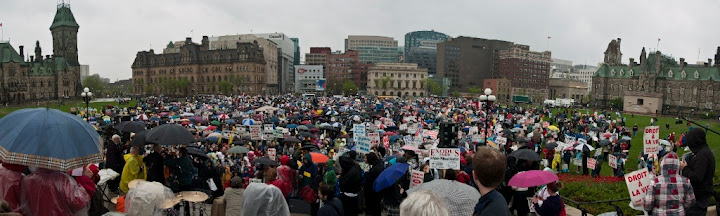
First Parliamentary debate on Bill C-384
The first hour of debate saw eight MPs rise to speak on the issue. Two were in favour – Bloc MPs Lalonde and Serge Cardin (Sherbrooke). Six were opposed – David Anderson (C, Cypress Hills – Grasslands), John McKay (L, Scarborough – Guildwood), Jacques Gourde (C, Lotbinière – Chutes-de-la-Chaudière), Marlene Jennings (L, Notre-Dame-de-Grâce – Lachine), Joe Comartin (NDP, Windsor – Tecumseh) and Paul Szabo (L, Mississauga South).
Speaking in favour of her bill, Lalonde said C-384 “amends the Criminal Code so that a medical practitioner does not commit homicide just by helping a person to die with dignity.”
Lalonde noted Quebec medical professionals support legalizing physician-assisted suicide and pointed to polls from Quebec that purport to show the public supports her bill. She also reiterated some of the supposed safeguards her bill includes, such as requiring that those who request euthanasia or physician-assisted suicide be 18 years or older, that individuals have to be experiencing “severe” physical or mental pain and that two written requests must be made at least 10 days apart expressing the wish to die.
Gourde raised issues about the lack of safeguards. “Bill C-384 is too broad in terms of its scope,” he said, noting that, “The proposed legalization of medical euthanasia and assisted suicide would not only apply to terminally ill patients, but also to persons who suffer from severe physical or mental pain without any prospect of relief.” He noted that those who were depressed could request a physician’s assistance in committing suicide.
For the rest of the article refer here
Monday, October 19, 2009
Letter asking Members of Parliament and all the people of Canada to reflect on the possible consequences of Bill C-384
The Parliament of Canada is soon expected to debate private member’s Bill C-384, an Act to amend the Criminal Code (right to die with dignity), which aims at legalizing euthanasia and assisted suicide in Canada.
Those wishing to re-open this debate are no doubt motivated by concern for the sufferings of others. An unfortunate understanding of compassion has led them to suggest euthanizing the most vulnerable instead of providing them with proper care, effective pain control, and social, emotional and spiritual support until their natural death. It is always important to be as clear as possible about intentions and possible consequences when we consider human acts, so as to assure the greatest good and limit any harm to the persons directly affected and also to the wider community.
Unfortunately, some of the terms being proposed for this debate are misleading or unclear. This can only lead to discussions that are confusing and unhelpful, and also makes it difficult to find common ground from which to assess the risks and impact of
proposals for new legislation.
From the Catholic perspective, it is legitimate to use medication and other means to alleviate suffering, even if a side effect can be the shortening of life expectancy. It is also legitimate for someone to refuse medical procedures that are found to be especially
burdensome. But what is never acceptable is the direct and intentional killing of the depressed, handicapped, sick, elderly or dying (Catechism of the Catholic Church, nos. 2276-77).
It is hard to see how any legislation legalizing euthanasia and assisted suicide would protect the most vulnerable in our society. What confidence and trust could they possibly have that their lives would continue to be protected by health-care providers, family and friends, or society at large? Euthanasia and assisted suicide, by their very nature, mean there is no longer a common duty for all to protect the lives of others. There is also the well-founded fear that euthanasia and assisted suicide can be imposed on individuals as a way to save costs and lessen demands on care-givers. Inevitably, the result would be a society even more fragmented, with its members living in greater isolation and anxiety.
As this debate resumes in our country on such an important question, the Catholic Bishops of Canada invite:
- The members of the Parliament of Canada – elected representatives in the House of Commons as well as Senators – to use clear definitions in their upcoming debates, and also to consider the profound impact that such legislation would have on the lives of individuals and on the wider community;
- All Canadians to become better informed about euthanasia and assisted suicide, and to promote instead palliative and home care to help those in need and their care-givers;
- Catholics, our brothers and sisters who belong to other Christian communities orother faiths, and all who appreciate the beauty and dignity of life, to engage in this debate civilly and respectfully, so as to witness a profound reverence for the
inherent dignity of each and all human life.
Most Reverend V. James Weisgerber
Archbishop of Winnipeg
President of the Canadian Conference of Catholic Bishops
Courtesy - CCCB
Tuesday, June 9, 2009
Euthanasia & Assisted Suicide in Canada Bill C384
On May 13, 2009 Francine Lalonde MP (BQ - La Pointe-de-l’Île) introduced Bill C-384: An Act to amend the Criminal Code (right to die with dignity).
Previously, Lalonde introduced Bill C-562 (June 2008) and Bill C-407 (June 2005). Bill C-384 is identical to Bill C-562 while Bill C-407 was very similar.
Lalonde’s husband Guy Lemarche is the communications director of the euthanasia lobby group - l’Association québécoise pour le droit de mourir dans la dignité (AQDMD).
Bill C-384 would amend subsections 222(7) and subsection 241(2) of the Criminal Code.
Euthanasia is a deliberate act undertaken by one individual with the intention of ending the life of another individual to relieve that person’s suffering, where the act is the cause of death. (Of Life and Death - 1995)
Bill C-384 legalizes euthanasia by amending subsection 222(7) of the Criminal Code. Section 222 is the homicide provision within the criminal code.
Assisted suicide is the act of intentionally killing oneself with the assistance of another who provides the knowledge, means or both. (Of Life and Death - 1995)
Bill C-384 legalizes assisted suicide by amending subsection 241(2) of the criminal code. Section 241 is the assisted suicide provision within the criminal code.
Bill C-384 amends the Criminal Code by adding to subsections 222(7) and 241(2) exceptions whereby the law is circumvented.
Bill C-384 states that the person must be at least eighteen years old. It may be unconstitutional because it limits what is determined by the bill to be appropriate medical treatment only based on the age of the individual. Since the constitution recognizes that everyone is equal under the law, it may be unconstitutional to limit the rights of individuals, based on age, without good reason.
Bill C-384 states that the individual is eligible: "after trying or expressly refusing the appropriate treatments available that they continue to experience severe physical or mental pain without any prospect of relief."
The bill states that an individual is eligible for intended death if they experience severe physical pain without any prospect of relief.
For more details refer to the following link